The transition to renewable energy depends on a single, sophisticated device: the solar photovoltaic (PV) module. While we often focus on the silicon cells, a solar panel is actually a sandwich of advanced materials designed to survive 25+ years in harsh outdoor environments.
Below is a technical breakdown of the essential materials that make up a high-efficiency solar panel.
The Semiconductor Solar Grade Silicon
The engine of the panel. Most modern panels use Monocrystalline Silicon or Polycrystalline Silicon.
- The Science: Pure silicon is “doped” with Boron or Phosphorus to create a P-N junction.
- Modern Shift: The industry has largely moved to N-type TOPCon and PERC technologies, which add specialized thin-film layers to capture more electrons that would otherwise be lost.
Solar Glass
The front layer is almost always High-Transmission Tempered Glass.
- Key Properties: It must be “low-iron” to ensure maximum light transparency.
- Coatings: An Anti-Reflective (AR) coating is applied to reduce the amount of light bouncing off the surface, ensuring photons reach the silicon cells.
Encapsulant
This is a transparent polymer layer that bonds the cells to the glass and backsheet.
- EVA (Ethylene Vinyl Acetate): The most common material. It is processed under vacuum and heat (lamination) to become a clear, protective seal.
- POE (Polyolefin Elastomer): Often used in high-efficiency and bifacial panels because it has better water resistance and prevents Potential Induced Degradation (PID).
PV Ribbon and Interconnect Wire
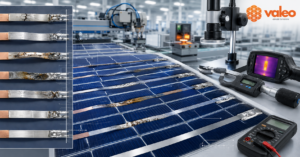
Function: They connect cells in series to build voltage.
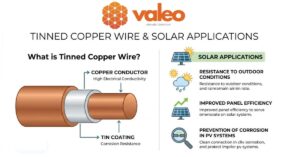
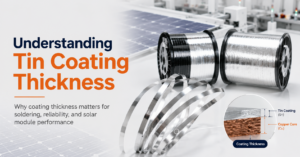
Material: Oxygen-free copper coated with a specialized solder alloy (Tin-Lead or Lead-Free).
The Backsheet
The rear layer provides electrical insulation and protects against moisture and UV radiation.
- Materials: Common materials include Tedlar (PVF) or Kynar (PVDF).
- Bifacial Panels: In double-sided panels, the backsheet is replaced by a second layer of tempered glass to allow light to enter from the rear.
Also Read: Copper Conductors in Renewable Energy Systems Complete Guide
Aluminum Frame
The frame provides structural rigidity, allowing the panel to withstand heavy snow loads and high winds.
- Finish: Usually Anodized Aluminum, which creates a corrosion-resistant oxide layer, essential for coastal or humid environments.
Junction Box
Located on the back of the panel, this box houses the electrical connections.
- Bypass Diodes: These are critical components inside the box that prevent “hot spots” by allowing current to bypass cells that are shaded or damaged.
FAQs
Low-iron glass is used in solar panels because it is much clearer than standard window glass. Regular glass contains iron, which gives it a green tint and absorbs part of the sunlight. Low-iron glass allows up to 91–93% of light to pass through to the solar cells. This improves solar panel efficiency and increases overall power generation.
Most solar panel materials are engineered to perform reliably for 25 to 30 years or more. Components such as glass, aluminum frames, and copper interconnects are highly durable. Over time, encapsulants may yellow and junction boxes may be affected by moisture ingress. Using high-quality materials helps maximize the lifespan and performance of solar modules.
Yes, solar panels are recyclable, although the process requires specialized equipment. Around 90% of the glass and aluminum frame can be recovered and reused. Valuable materials such as copper ribbons, silver, and silicon can also be extracted through advanced processing. Recycling supports sustainability and reduces waste in the solar industry.
EVA is the most commonly used encapsulant because it is cost-effective and widely proven in solar manufacturing. POE offers better resistance to moisture and chemical degradation, making it ideal for bifacial and N-type solar panels. POE helps protect sensitive rear-side cell coatings and improves long-term reliability. Both materials play a critical role in safeguarding solar cells.
The aluminum frame does not directly improve the electrical output of a solar panel. Its main functions are to provide structural support, mounting points, and mechanical protection. The frame must be properly grounded to ensure electrical safety and lightning protection. It is an important component for both installation and long-term durability.
Yes, low-quality backsheets can crack, chalk, or degrade over time due to prolonged UV exposure and weather conditions. Backsheet failure can lead to moisture ingress and electrical insulation problems. Premium solar panels use high-grade fluoropolymer materials to ensure long-lasting protection. A durable backsheet is essential for maintaining solar panel performance over decades.