How MBB Solar Cell Geometry Affects Interconnect Ribbon Selection
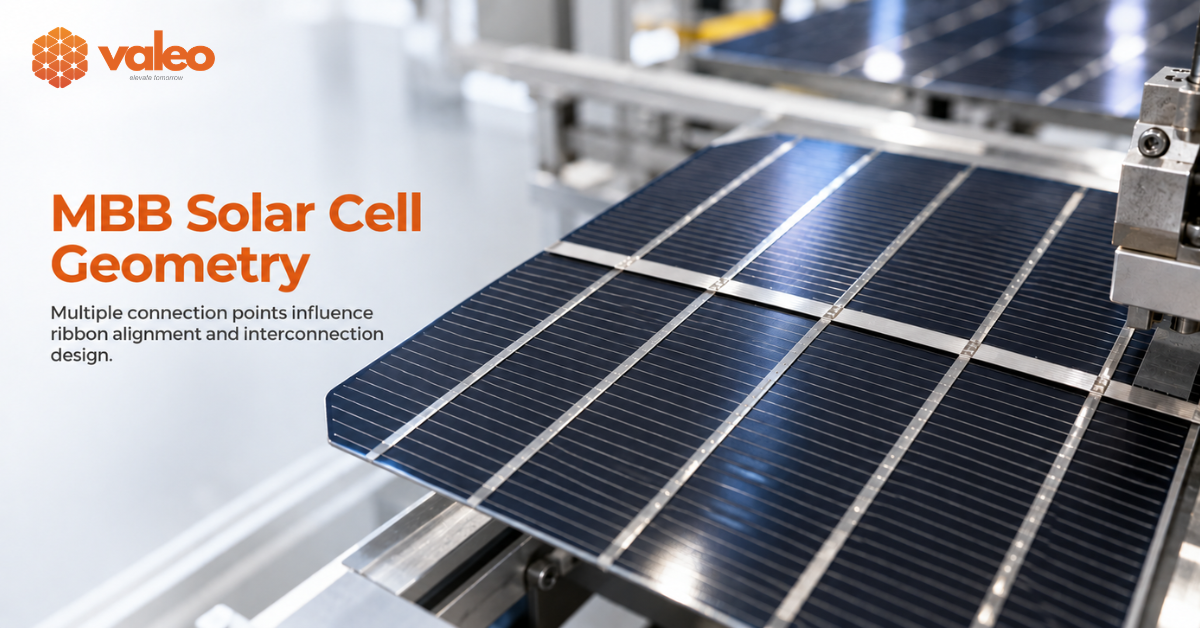
MBB solar cells use multiple connection points across the cell instead of a small number of widely spaced busbars. This changes how manufacturers approach cell interconnection because contact layout, spacing and arrangement need to work with the interconnect design and production process. Ribbon selection should therefore start with MBB cell geometry and then move to dimensions, coating, alloy and handling requirements.
MBB solar cell geometry determines interconnect ribbon selection by defining the required ribbon alignment, width, thickness, coating and alloy for the cell’s connection-point layout. Manufacturers should match ribbon specifications to the specific MBB cell design and production process.
What Are MBB Solar Cells?
MBB solar cells use multi-busbar technology, with multiple thin conductive lines distributed across the cell to collect and carry electrical current. MBB designs typically use more busbars than traditional 4- or 5-busbar cell designs, with the exact number varying by cell technology and manufacturer.
How Does MBB Cell Geometry Affect Interconnection?
Manufacturers should first understand where the ribbon needs to connect on the cell. The number, position and spacing of connection points help define the required interconnection layout.
Closely arranged connection points make dimensional fit and alignment important. If the ribbon does not suit the contact layout, positioning can become more difficult during production. The ribbon also needs to work with the equipment used for placement and soldering.
MBB interconnection should therefore be treated as a cell-specific application rather than a search for one universally suitable ribbon.
For a broader overview of MBB ribbon requirements and applications, see our guide to MBB ribbon
How Does Connection-Point Spacing Affect Ribbon Selection?
Connection-point spacing affects how the ribbon sits across the intended contact areas. Two MBB cell designs can have different spacing, so the same ribbon width may not provide the same fit for both.
Width should be evaluated against the contact area and connection arrangement. The aim is suitable contact and consistent placement without unnecessary alignment challenges.
Thickness is another supporting factor. It can influence how the ribbon handles, bends and responds during soldering. The appropriate thickness depends on the cell design and production process.
There is no single MBB ribbon dimension for every cell. Detailed dimensions should be checked against the actual application. Broader dimensional information can be covered by a dedicated PV ribbon dimensions guide.
Which Ribbon Dimensions Need to Match the MBB Cell?
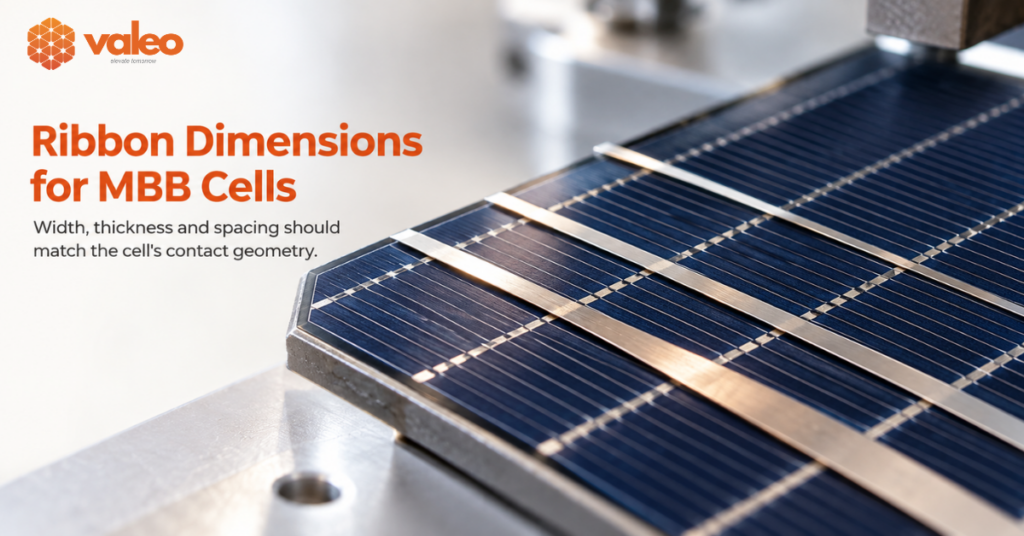
Ribbon dimensions should be evaluated as part of the complete cell-interconnection setup. Width needs to suit the contact area and spacing, while thickness needs to be compatible with handling, bending and the intended production process.
Dimensional consistency also matters in repeated manufacturing. Small variations can affect placement across many cells, so manufacturers should consider whether the selected ribbon can be handled and positioned consistently by production equipment.
How Do Coating and Alloy Requirements Depend on the MBB Cell?
Coating and alloy are part of the cell-interconnection requirements. The selected coating should suit the cell contact and provide the required solderability under the intended production conditions.
Manufacturers should evaluate coating and alloy together with soldering conditions and cell-contact requirements. The objective is a stable interconnection process rather than choosing an alloy simply because of its name.
What Should Manufacturers Check Before Selecting a Ribbon for MBB Cells?
A practical evaluation can begin with these questions:
- What cell technology and MBB configuration are being used?
- How many connection points are present?
- What are their spacing and arrangement?
- What ribbon geometry fits the contact layout?
- What width and thickness suit the cell and production process?
- Is the conductor suitable for the electrical and mechanical requirements?
- Does the coating or alloy suit the interconnection process?
- Can the ribbon be positioned and handled consistently by production equipment?
How Can Ribbon Selection Affect MBB Production?
Ribbon selection can influence alignment, soldering consistency and automated handling. When ribbon geometry is compatible with the cell layout and equipment, positioning can be more predictable across repeated connections.
Consistency matters in high-volume production because small dimensional or surface variations can be repeated across many cells.
When Should Manufacturers Consider a Custom Ribbon?
A custom ribbon can be considered when a standard specification does not adequately match the MBB cell or production setup. The need may relate to connection geometry, dimensions, coating or alloy requirements, or equipment conditions.
MBB Solar Cells and Ribbon Selection
The right interconnect ribbon for an MBB solar cell depends on the cell’s connection geometry and interconnection requirements. Manufacturers should evaluate connection-point spacing and arrangement first, followed by width, thickness, conductor, coating, alloy and production compatibility. There is no single ribbon specification for every MBB cell design.
Evaluating Interconnect Ribbons for MBB Applications
Valeo Products provides solar interconnect solutions for different cell and module requirements. For MBB applications, ribbon selection can be evaluated against cell technology, connection geometry, dimensions, coating and production conditions.
Conclusion
MBB solar cell design should be the starting point for interconnect ribbon selection. Connection-point count, spacing and arrangement determine the fit the ribbon needs to achieve, while width, thickness, coating, alloy and production compatibility support the complete interconnection process.
FAQs About MBB Solar Cells and Interconnect Ribbon Selection
MBB solar cells are multi-busbar solar cells that use multiple connection paths across the cell. Their connection points are arranged more closely than in many earlier busbar designs.
MBB cell geometry determines how the interconnect ribbon must align with the cell. Connection-point number, position and spacing should be evaluated before selecting ribbon dimensions and other specifications.
No, there is no single ribbon size that suits every MBB solar cell. Ribbon width and thickness should be matched to the cell layout, contact geometry and production process.
Connection spacing determines how the ribbon fits and aligns with the cell contacts. Different MBB layouts can therefore require different ribbon dimensions and placement requirements.
Manufacturers should consider a custom ribbon when a standard specification does not adequately match the cell or production process. Customization may involve ribbon dimensions, coating, alloy or other interconnection requirements.