PV Ribbon Thickness: Standard Dimensions Guide
PV ribbon thickness is one of the most important decisions in solar module manufacturing. While solar cells receive most of the attention, the copper ribbons that connect them play a critical role in electrical efficiency, soldering quality, and long-term module reliability.
Using the wrong ribbon thickness can increase electrical resistance, create weak solder joints, or even lead to cell microcracks during production. That’s why manufacturers carefully evaluate standard PV ribbon thickness, PV ribbon dimensions, and ribbon thickness tolerance before selecting materials.
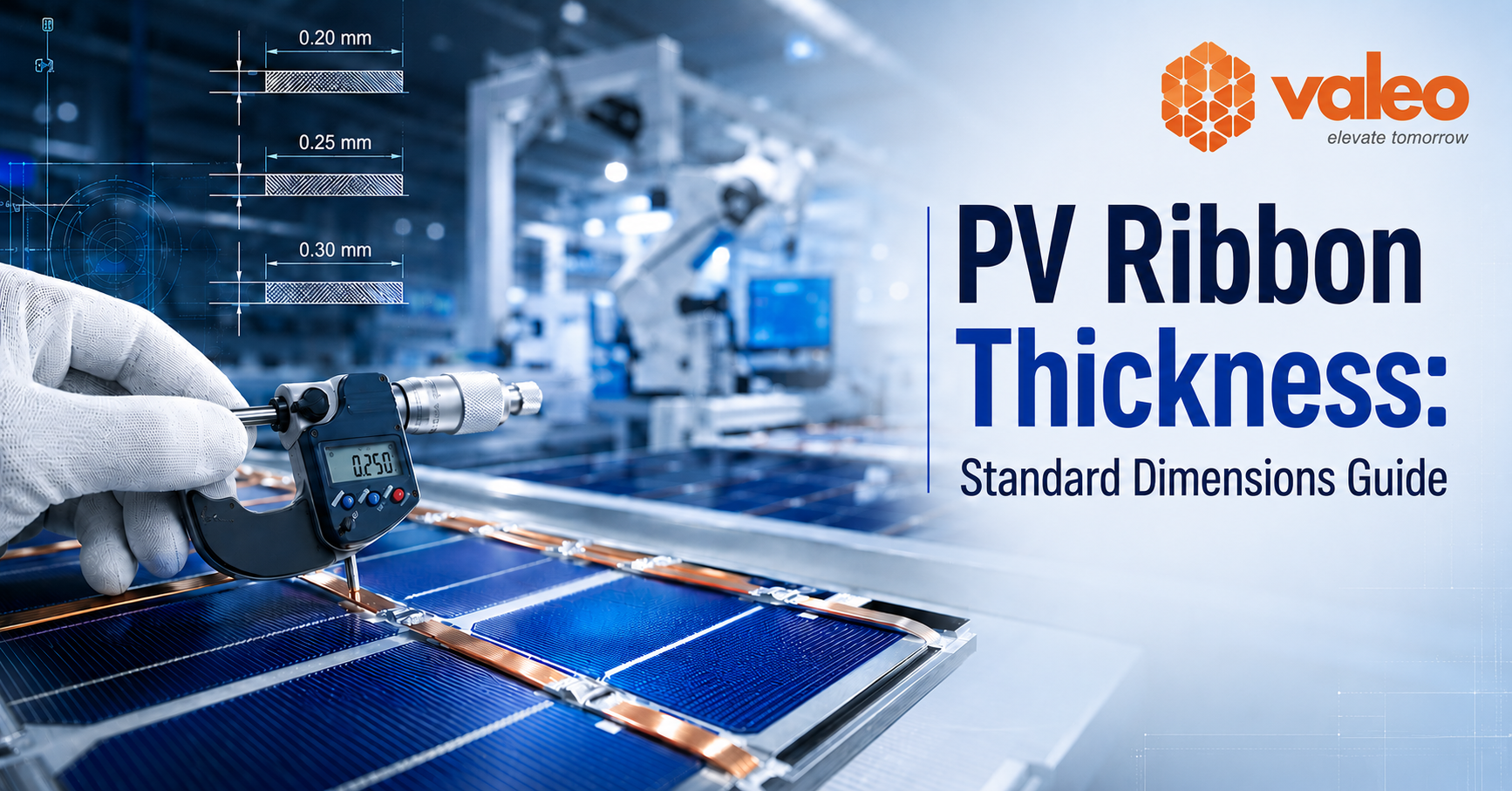
The standard PV ribbon thickness typically ranges from 0.18 mm to 0.35 mm, depending on the solar cell technology, current-carrying requirements, and module design. Choosing the right thickness improves electrical conductivity, ensures reliable soldering, reduces production defects, and enhances the long-term performance of photovoltaic modules.
Also read : pv ribbon manufacturer in india
What Is PV Ribbon Thickness?
PV ribbon thickness refers to the vertical dimension of the flat, tin-coated copper ribbon used to electrically connect solar cells inside a photovoltaic (PV) module. Measured in millimeters (mm), ribbon thickness influences electrical conductivity, mechanical strength, flexibility, and current-carrying capacity.
A typical PV ribbon consists of:
- A high-conductivity copper core
- A uniform tin or tin-alloy coating
- Precision-controlled dimensions for consistent quality and performance
The ribbon carries electrical current between interconnected solar cells, making accurate thickness an important factor in maintaining consistent electrical performance and manufacturing quality throughout the life of the solar module.
Why PV Ribbon Thickness Matters
Selecting the correct ribbon thickness impacts both manufacturing efficiency and the long-term reliability of solar modules.
The right thickness helps achieve:
- Lower electrical resistance
- Better current-carrying capacity
- Strong and consistent solder joints
- Reduced thermal stress
- Improved mechanical durability
- Higher module efficiency and lifespan
If the ribbon is too thin, it may overheat under higher current loads or become mechanically weak during production.
If the ribbon is too thick, it can place excessive stress on fragile solar cells during soldering, increasing the risk of microcracks and reduced manufacturing yield.
For solar manufacturers, selecting the appropriate ribbon thickness means fewer production defects, improved process stability, and lower warranty claims.
Standard PV Ribbon Thickness in mm
Although ribbon specifications vary according to module design and cell technology, the following thickness ranges are commonly used across the solar industry.
Application | Standard PV Ribbon Thickness |
Standard Cell Interconnection | 0.18 mm – 0.25 mm |
High-Current Solar Modules | 0.25 mm – 0.35 mm |
Busbar Ribbon Applications | 0.30 mm – 0.50 mm |
The ideal thickness depends on several design factors, including:
- Solar cell technology (PERC, TOPCon, HJT, etc.)
- Module output current
- Number of busbars
- Cell configuration
- Manufacturing process
Rather than selecting the thickest ribbon available, manufacturers should choose dimensions that balance electrical performance with mechanical reliability.
PV interconnect ribbon specifications
PV Ribbon Width and Thickness: What's the Difference?
Many buyers focus only on thickness, but PV ribbon width and thickness should always be evaluated together.
Typical PV ribbon dimensions include:
- Width: 1 mm to 6 mm
- Thickness: 0.18 mm to 0.50 mm
Each dimension influences module performance differently.
| Dimension | Primary Consideration |
| Thickness | Mechanical strength, flexibility, and current-carrying capacity |
| Width | Electrical resistance, current distribution, and application requirements |
For example, increasing ribbon width may reduce electrical resistance without significantly increasing stress on the solar cell. A well-balanced combination of width and thickness delivers better overall performance than optimizing either dimension independently.
Factors That Determine the Right PV Ribbon Thickness
There is no universal ribbon thickness suitable for every solar module. Manufacturers should consider multiple technical factors before selecting a specification.
1. Solar Cell Technology
Modern technologies such as PERC, TOPCon, and HJT have different electrical and thermal characteristics. Each technology requires ribbon dimensions that match its current output and soldering requirements.
2. Current-Carrying Requirements
Higher-power modules generate greater electrical current, requiring ribbons with sufficient cross-sectional area to minimize resistance and heat generation.
3. Module Design
The number of cells, busbar layout, and overall module size all influence ribbon selection.
4. Manufacturing Process
Ribbon thickness should be compatible with automated stringing equipment, soldering temperatures, and production speeds to ensure consistent manufacturing quality.
Ribbon Thickness Tolerance: Why Precision Matters
Choosing the correct specification is only part of the equation. Maintaining a tight ribbon thickness tolerance is equally important.
Even small dimensional variations can result in:
- Uneven solder joints
- Poor electrical contact
- Increased electrical resistance
- Inconsistent module quality
- Higher production rejection rates
During automated stringing and soldering, even minor thickness inconsistencies can affect solder wetting, ribbon alignment, and overall assembly quality.
For this reason, reputable PV ribbon manufacturers maintain strict dimensional controls throughout production to ensure every batch performs consistently.
Common PV Ribbon Dimensions
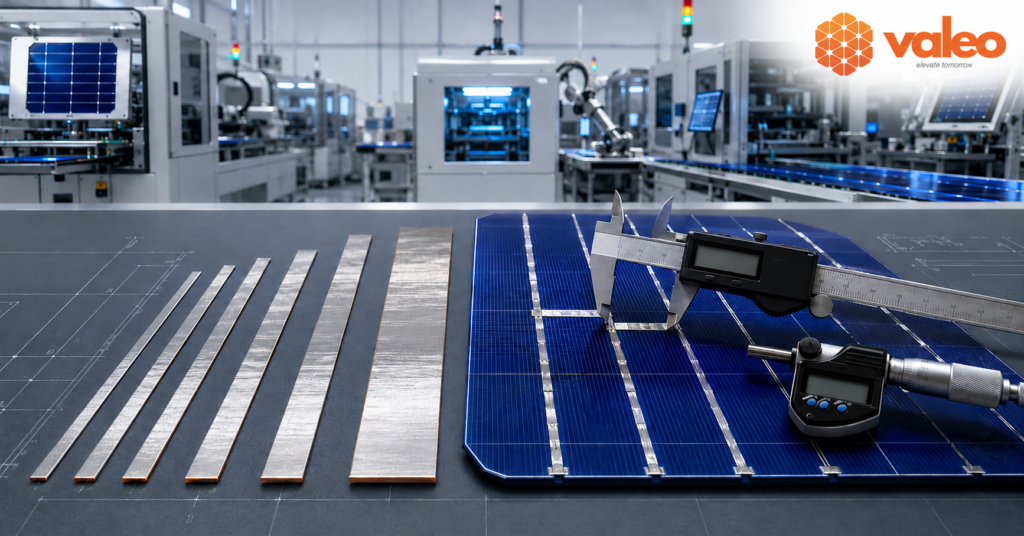
The following PV ribbon dimensions are widely used in solar module manufacturing.
Width | Thickness | Typical Application |
1.5 mm | 0.20 mm | Standard Cell Connections |
2.0 mm | 0.20 mm | Residential Solar Modules |
2.5 mm | 0.25 mm | Commercial Solar Modules |
3.0 mm | 0.25 mm | High-Efficiency Modules |
5.0 mm | 0.30 mm | Busbar Ribbon Applications |
Custom dimensions may be required depending on the module design, electrical requirements, and production process.
How Valeo Products Ensures Consistent PV Ribbon Quality
Consistent ribbon quality requires advanced manufacturing expertise and rigorous quality control.
At Valeo Products, every production batch undergoes comprehensive inspection using precision testing equipment to verify dimensional accuracy and coating consistency.
Our in-house quality testing includes:
- Precision Micrometers for thickness measurement
- Vernier Calipers for dimensional verification
- Non-Contact Laser Gauges for high-accuracy inspection
- Tensile Testing Machines for mechanical strength evaluation
- Surface Microscopy for coating inspection
- XRF (X-Ray Fluorescence) testing to verify tin coating composition and uniformity
These quality checks help ensure consistent PV ribbon dimensions, uniform coating quality, and dependable electrical performance for solar module manufacturers.
Why Solar Manufacturers Choose Valeo Products
At Valeo Products, we manufacture high-quality PV ribbons designed to meet the demanding requirements of modern solar module production.
Our advantages include:
- Precision-controlled PV ribbon dimensions
- Tight ribbon thickness tolerances
- High-purity, high-conductivity copper materials
- Uniform tin coating with consistent coating quality
- Advanced in-house testing and quality inspection
- Custom ribbon sizes for diverse applications
- Reliable supply for large-scale manufacturing
Our engineering team works closely with customers to recommend the most suitable ribbon dimensions based on their cell technology, current requirements, and manufacturing process, ensuring the right solution for their production needs.
Conclusion
PV ribbon thickness plays an important role in the electrical characteristics, mechanical strength, and current-carrying capacity of solar modules. Choosing the appropriate ribbon dimensions helps manufacturers match the ribbon to their solar cell technology, module design, and production requirements. Working with a manufacturer that offers precise dimensional control and customized ribbon solutions supports consistent manufacturing quality and reliable electrical performance.
Need help selecting the right PV ribbon dimensions? Contact the technical team at Valeo Products to discuss your manufacturing requirements or explore our complete range of PV Ribbon solutions designed for modern solar module production.