Understanding Solar Interconnect Coating Thickness
When it comes to solar module manufacturing, small differences in interconnect quality can affect soldering, connection reliability, and long-term module performance. One factor that deserves attention is solar interconnect coating thickness.
The copper core provides the electrical path, while the metallic coating creates a solderable surface and helps protect the copper from environmental exposure. The right coating thickness can help manufacturers achieve consistent soldering and choose an interconnect that fits their cell technology and production process.
In this guide, we’ll explain coating thickness, why it matters, how it differs from overall ribbon thickness, what affects the right coating thickness, and what manufacturers should consider when selecting an interconnect ribbon.
Also Read: PV Ribbon Thickness: Standard Dimensions Guide
What Is Coating Thickness?
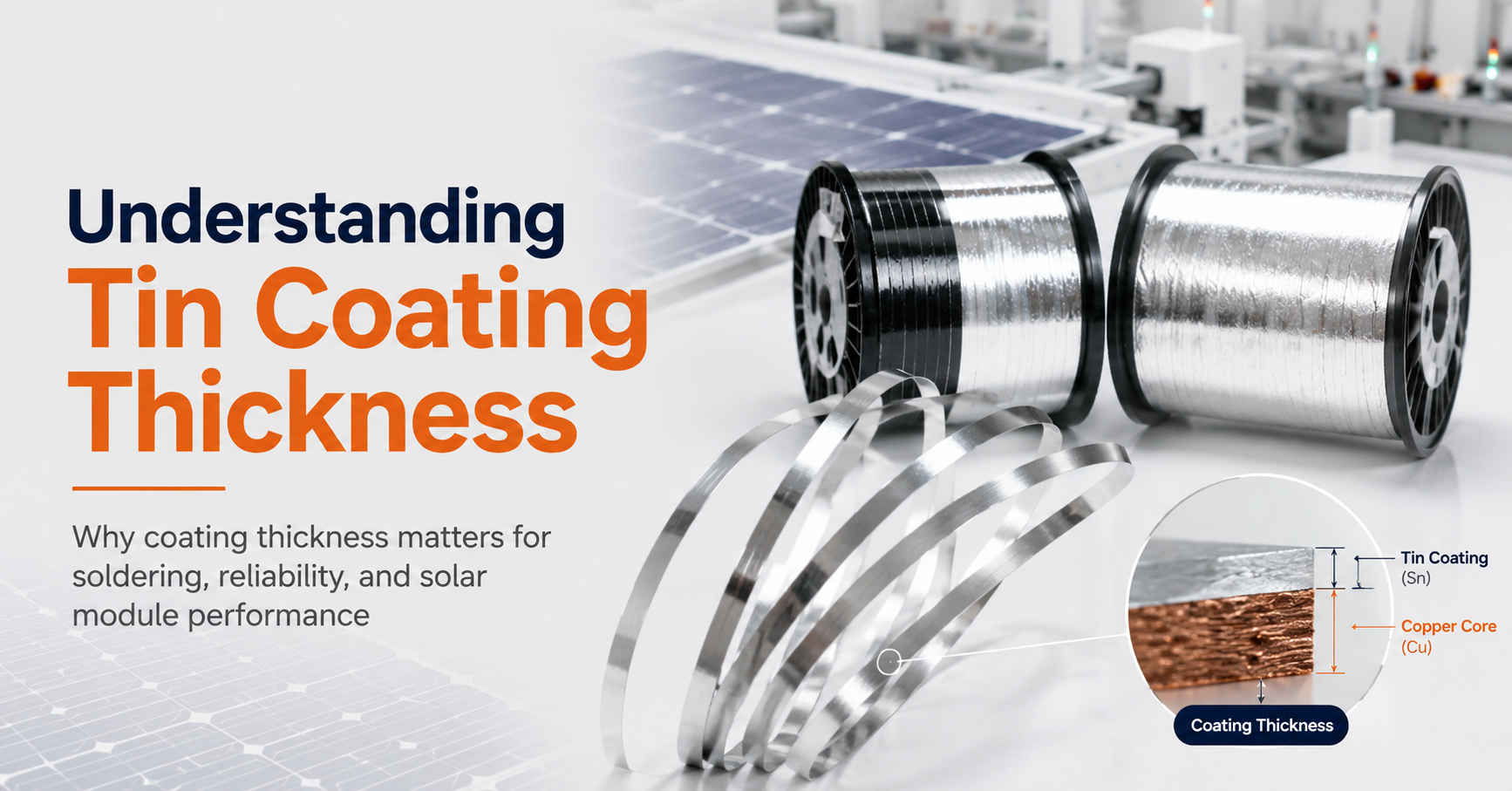
Coating thickness refers to the thickness of the metallic layer applied over the copper core. It is different from the total thickness of the ribbon.
The overall ribbon thickness includes both the copper core and the coating applied to its surface. Coating thickness, on the other hand, refers only to the outer layer.
There is no single coating thickness that works for every solar application. The appropriate specification depends on factors such as ribbon dimensions, coating alloy, solar cell technology, and the soldering process used during module assembly.
Why Coating Thickness Matters
It affects soldering
The coating forms the surface that interacts with solder during the joining process. A suitable coating can support consistent solder spreading and bonding across the ribbon.
If the coating specification is not suitable for the production process, manufacturers may experience inconsistent soldering results. This becomes particularly important in high-volume solar module production, where small variations can affect a large number of connections.
It protects the copper core
Copper provides excellent electrical conductivity, but its surface can oxidize when exposed to the environment.
The outer metallic coating provides an additional layer of protection over the copper. This helps maintain the surface characteristics required during manufacturing and can support the long-term performance of the connection.
It supports production consistency
Consistency is important when interconnect ribbons are produced and used at scale.
Variation in coating thickness from one section of ribbon to another can affect soldering behaviour and overall processing consistency. Maintaining a controlled coating specification helps manufacturers work with more predictable material during production.
It influences handling and thermal behaviour
The coating is part of the finished ribbon, so it can also influence how the material responds to heating, bending and handling.
This is particularly relevant during cell interconnection, where the ribbon is exposed to thermal cycles and mechanical movement as part of the assembly process.
Coating Thickness vs. Total Ribbon Thickness
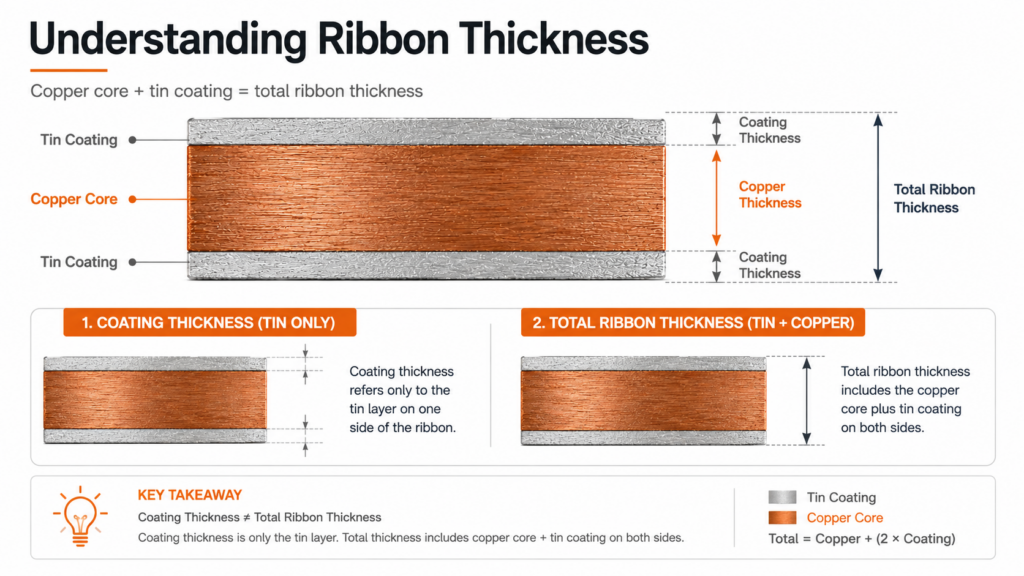
Coating thickness and total ribbon thickness describe different measurements.
| Term | What It Means |
|---|---|
| Copper thickness | Thickness of the copper core |
| Coating thickness | Thickness of the metallic layer applied over the copper |
| Total ribbon thickness | Combined thickness of the copper core and coating |
| Ribbon width | Width of the finished ribbon |
| Coating alloy | Metals used to form the outer coating |
What Decides the Right Coating Thickness?
Several factors can influence the coating specification required for a particular application.
Solar cell technology
Different cell technologies can have different requirements for interconnection and soldering.
Poly, Mono PERC and TOPCon cells may require different production conditions, making it important to consider the complete manufacturing process rather than selecting a coating specification based only on the ribbon itself.
Solar interconnect ribbons are commonly produced in widths from about 0.35 mm to 2.0 mm and thicknesses from about 0.15 mm to 0.30 mm, depending on the application and specification.
Coating alloy
The coating material also affects how the ribbon behaves during manufacturing.
Common coating options include:
- Sn/Pb
- Sn/Ag
- Sn/Ag/Cu
- Sn/Bi/Pb
- Sn/Bi/Ag
- Sn/Bi
Lead-free and low-temperature alloys can be selected for applications where specific processing temperatures or cell requirements need to be considered.
Soldering process
The production line itself is another important factor.
Soldering temperature, flux selection, heating method and the surface characteristics of the solar cell can all affect how the coating performs during assembly.
For this reason, coating thickness should be considered together with the complete soldering process.
Ribbon dimensions
Ribbon width and copper thickness also need to work with the selected coating.
A coating specification should therefore be evaluated alongside the overall ribbon dimensions rather than treated as an isolated measurement.
Is a Thicker Coating Always Better?
No.
A thicker coating does not automatically mean better performance. Once the coating reaches the level required for the intended application, adding more material may not provide a practical advantage.
It can also affect material usage, dimensions and production costs.
Instead of simply choosing the thickest available coating, manufacturers should determine the specification that matches their cell technology, soldering process, ribbon dimensions and production requirements.
How Is Coating Thickness Checked?
A suitable coating specification needs to be supported by consistent manufacturing and quality control.
Depending on the product specification, manufacturers may evaluate:
- Coating thickness
- Coating uniformity
- Ribbon width
- Total ribbon thickness
- Surface quality
- Solderability
- Coating adhesion
- Electrical performance
- Mechanical strength
These checks help verify that the material supplied matches the agreed technical specifications.
Consistent testing is especially important for high-volume module manufacturing, where variations in incoming material can affect production results.
What to Ask For When Buying Interconnect Ribbon
Instead of simply asking for a solar ribbon, manufacturers should provide their supplier with the complete technical requirements.
Important specifications may include:
- Copper thickness
- Ribbon width
- Total ribbon thickness
- Coating type
- Coating thickness
- Coating thickness tolerance
- Coating uniformity requirements
- Solar cell technology
- Soldering conditions
- Solderability requirements
- Mechanical strength requirements
Providing these details gives the supplier a clearer understanding of the intended application and helps avoid selecting a ribbon based on only one specification.
Choosing the Right Supplier
Getting the coating specification right on paper is only one part of the process. The supplier also needs to maintain that specification consistently across production batches.
Valeo Products manufactures solar interconnect ribbons for Poly, Mono PERC and TOPCon solar cells, with coating options including leaded, lead-free and low-temperature alloys.
With more than 40 years of experience in copper manufacturing and production capacity of up to 10,000 tons per year, Valeo Products focuses on consistent product specifications and quality checks aligned with ISO and RoHS requirements.
FAQs
Solar interconnect coating thickness refers to the thickness of the metallic layer applied over the copper core. It is different from the total thickness of the finished ribbon.
No. Ribbon thickness refers to the complete thickness of the finished ribbon, while coating thickness refers only to the outer metallic layer.
No. The coating should be suitable for the intended solar cell, soldering process and ribbon specification. A thicker coating does not automatically provide better performance.
The appropriate coating thickness depends on factors such as solar cell technology, coating alloy, ribbon dimensions, soldering conditions and production requirements.
Provide the supplier with the required copper thickness, ribbon width, total thickness, coating type, coating thickness, tolerance, solar cell type and soldering requirements.
Yes. Consistent coating across the ribbon can help provide more predictable soldering and production results, particularly in high-volume manufacturing.
Coating specifications can be selected based on the application and manufacturing requirements. Manufacturers should discuss the required coating type, thickness and tolerance with their supplier.
Coating thickness can influence soldering behaviour, surface protection and production consistency. The coating specification should therefore be matched to the ribbon, solar cell and module assembly process.