String Interconnect vs Cell Interconnect: Key Differences
When working with solar-module interconnection, cell interconnect and string interconnect can sound like two names for the same thing. They are related, but they describe different connection levels within a module. The difference is easiest to understand by looking at where the connection occurs and what role it performs.
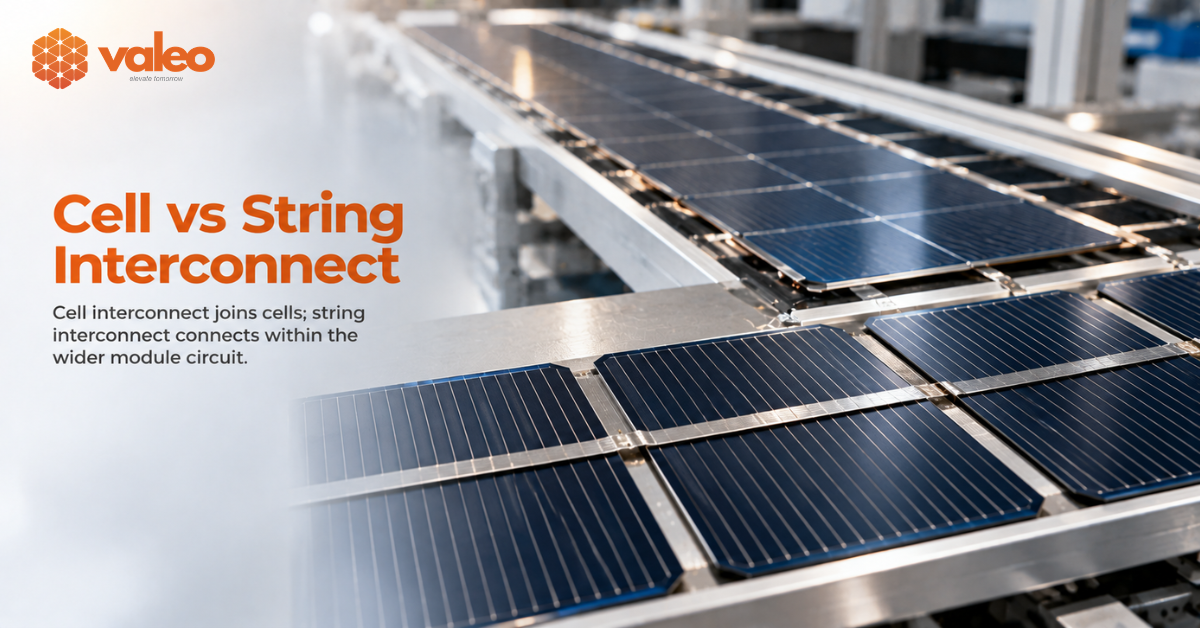
Cell interconnect refers to the connection between individual solar cells, while string interconnect refers to the connection or routing associated with a cell string within the wider module circuit. The main difference is the connection level and electrical role, not simply the material or physical appearance of the interconnect.
String Interconnect vs Cell Interconnect: Quick Comparison
Feature | Cell Interconnect | String Interconnect |
Connection level | Individual cells | Cell-string level |
Primary role | Cell-to-cell connection | String/module circuit connection |
Main reference | Cell contact layout | Module electrical architecture |
Connection point | Cell contact area | String or module circuit point |
Main design concern | Contact alignment | Electrical routing |
Selection basis | Cell requirements | Module requirements |
What Is the Difference Between Cell and String Interconnect?
The main difference between cell interconnect vs string interconnect is the level at which the connection is being considered.
At the cell level, interconnection relates to individual solar cells. The interconnect needs to work with the cell’s contact arrangement, connection geometry and intended electrical path. This makes the cell layout an important reference when evaluating the connection.
At the string level, the focus moves to a group of interconnected cells and its place within the wider module circuit. The design may therefore involve routing, connection points and integration with the module’s electrical architecture.
The two functions are connected because individual cell connections help form a string. However, they should not automatically be treated as interchangeable. Terminology can also vary across manufacturers and module designs, so the intended application should always be clear.
Cell Interconnect vs String Interconnect
Connection Level
Cell-level interconnection deals with individual solar cells and their connection layout. The position and arrangement of cell contacts can influence how the interconnect needs to be placed.
String-level interconnection deals with a completed or developing cell string and how it connects or routes within the wider module circuit. Here, the module architecture becomes a more important reference.
For a detailed explanation of cell interconnect for solar modules, see Valeo’s dedicated guide on cell-level interconnection. For the string side, see the guide to string interconnect for solar modules.
Electrical Role
The electrical role also changes with the connection level.
Cell interconnection provides electrical continuity between individual cells and contributes to forming a cell string. The connection therefore needs to match the cell contacts and the intended electrical path.
String interconnection is considered at the cell-string or module-circuit level. Attention shifts toward how the string connects or routes within the wider electrical system of the module.
Design Reference
The design reference is another practical difference between cell vs string interconnect.
For cell interconnection, the solar cell is the primary reference. Contact arrangement, cell layout and connection geometry can influence the required design.
For string interconnection, the module’s electrical architecture becomes more important. String arrangement, connection locations and routing requirements can affect how the interconnect fits into the completed circuit.
Application Within Module Assembly
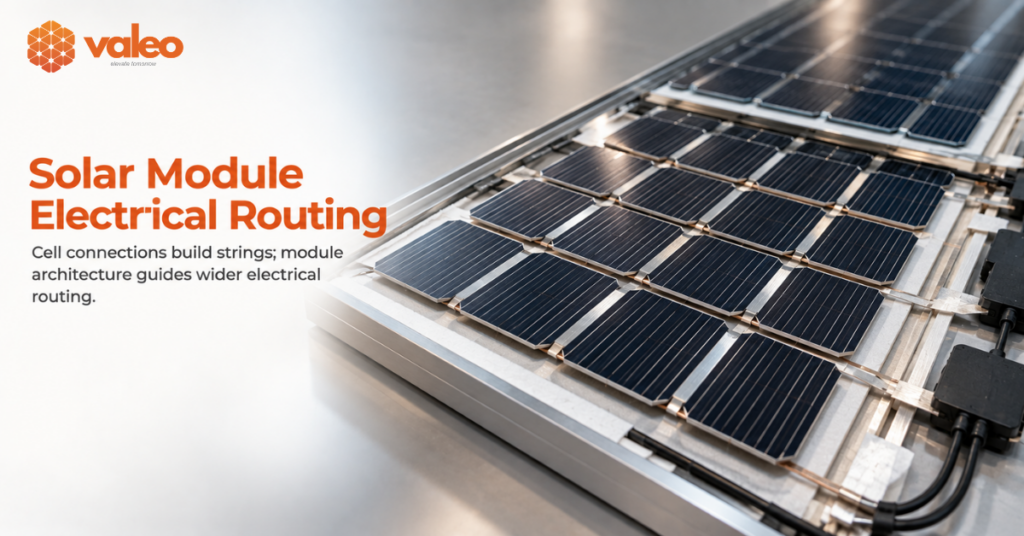
Individual solar cells are connected to form a cell string. Cell interconnection therefore concerns the relationships between those cells. Once the string is formed, string-level interconnection concerns how that string connects or routes within the wider module circuit.
This article focuses on the comparison rather than the complete solar-module connection process. For a broader overview of how solar cells are electrically connected, see Valeo’s guide to How Solar Panels Are Connected Using PV Ribbon and Interconnect Wire.
Why Does the Difference Matter?
Understanding the difference between solar cell interconnection and string-level interconnection helps engineering and production teams define requirements more clearly.
A cell-level requirement may depend on contact layout, connection geometry and alignment. A string-level requirement may depend more heavily on module architecture, electrical routing and connection locations.
Before selecting an interconnect design, manufacturers can consider:
- Where will the connection occur?
- What electrical function will it perform?
- What contact or connection points are involved?
- How does the module architecture affect routing?
- What production conditions need to be supported?
This keeps selection tied to the actual application.
Can One Interconnect Serve Both Roles?
A similar interconnect design may sometimes be suitable for different applications, but this should not be assumed from its appearance alone.
The connection location, electrical function, module architecture, mechanical integration and production conditions should be evaluated before deciding whether one design can serve both roles. In other words, application determines suitability more than terminology alone.
Valeo Products and Solar Interconnection
Valeo Products manufactures interconnect solutions for solar applications. The appropriate configuration depends on the intended connection, cell or module architecture, electrical design and production conditions.
For product configurations and commercial specifications, refer to Valeo’s Tinned Copper Interconnect product page.
Conclusion
The difference between string interconnect vs cell interconnect is mainly about connection level and electrical role. Cell interconnect is considered at the individual-cell connection level, while string interconnect relates to a cell string and its connection or routing within the wider module circuit.
Rather than treating the two terms as interchangeable, manufacturers should first identify the intended connection and electrical function. This creates a clearer basis for evaluating interconnect design, module integration and production requirements.
FAQs
The primary difference is the connection level. Cell interconnect is considered at the individual cell-to-cell level, while string interconnect is considered in relation to a cell string and the wider module circuit.
The distinction is mainly where the connection fits within the electrical architecture. Cell interconnect relates to individual cell connections, whereas string interconnect relates to a cell string's connection or routing within the module circuit.
Different connection levels can have different contact locations, routing requirements, electrical functions and integration constraints. The intended application should be established before selecting the physical specification.
They should not automatically be treated as the same. Terminology can vary, and suitability depends on the connection role, module architecture and production requirements.
Yes. Cell-level requirements are closely connected to cell contact layout, while string-level requirements are more closely connected to module architecture, string arrangement, connection points and routing.
It may be possible in some module designs, but this requires evaluation of the connection location, electrical function, mechanical integration and production conditions.