How the PV Ribbon Manufacturing Process Works
The PV ribbon manufacturing process turns copper into a thin, flat conductor used to connect solar cells inside photovoltaic modules. While PV ribbon may look simple, producing it consistently requires careful control of material quality, dimensions, surface condition, coating, and final inspection.
For solar manufacturers, ribbon quality can affect soldering, automated handling, electrical performance, and production consistency. The process is therefore a controlled production sequence designed around solar module manufacturing.
What Is PV Ribbon?
PV ribbon is a flat, conductive metallic ribbon used to connect solar cells and carry electrical current through a photovoltaic module. Copper is commonly used because it offers high electrical conductivity and can be formed into thin, flexible ribbon.
PV ribbon can vary in width, thickness, surface finish, and coating configuration. Tinned copper ribbon is commonly selected when a solderable surface is required for cell interconnection.
photovoltaic technology
What Is the PV Ribbon Manufacturing Process?
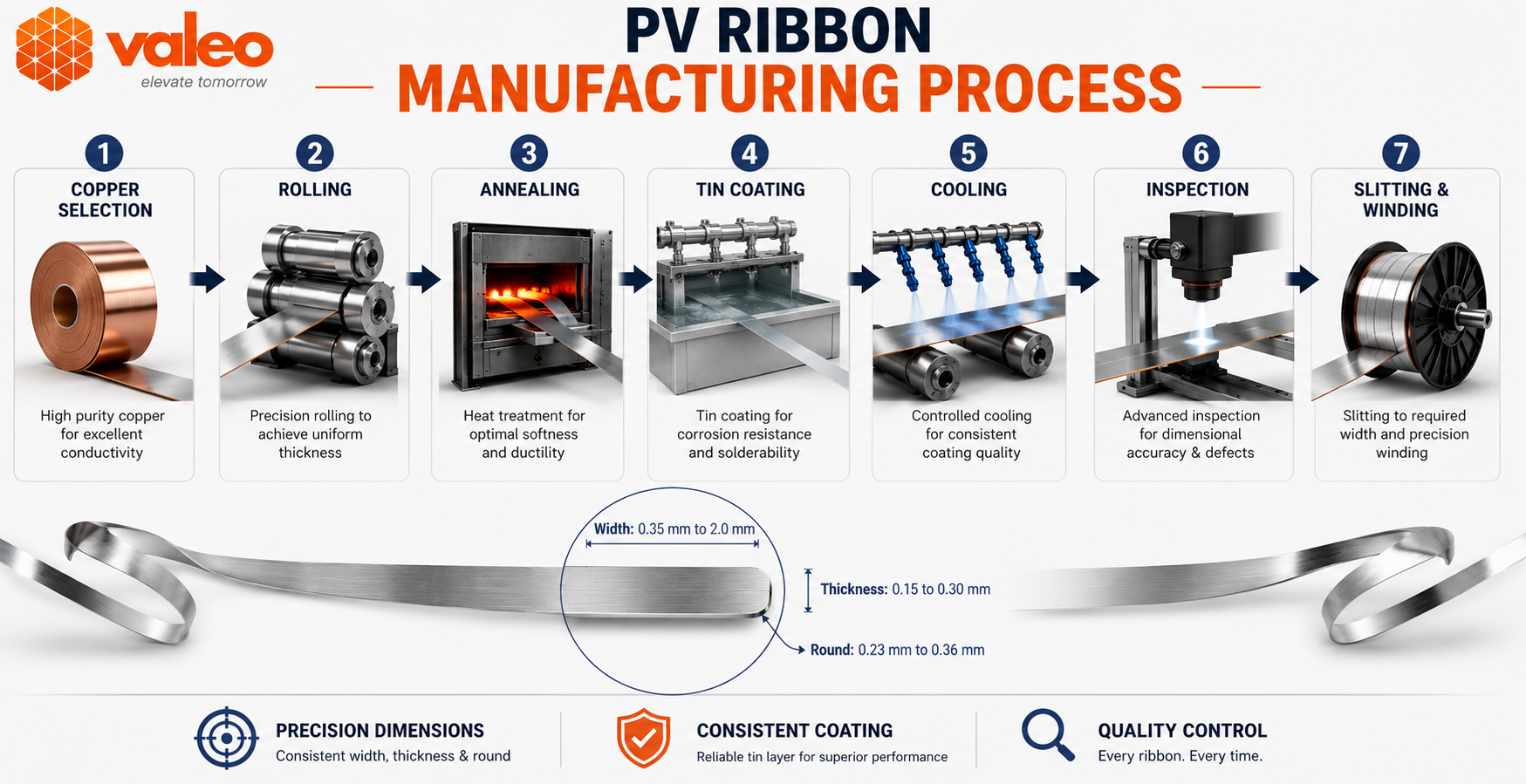
The PV ribbon manufacturing process converts copper feedstock into a thin, flat ribbon through several controlled stages:
Copper selection → Rolling and sizing → Surface preparation → Tinning or coating → Cooling → Inspection → Slitting and winding → Final testing
The process depends on ribbon dimensions, coating, cell technology, interconnection method, and application.
How Is PV Ribbon Manufactured?
PV ribbon is made by taking copper, rolling it into a thin ribbon, preparing the surface, and adding a tin coating when required. The finished ribbon is then checked and wound for use in solar module manufacturing.
Also Read : Solar Ribbon Manufacturer in India
1. Copper Material Selection
Production begins with copper feedstock that meets the required electrical, mechanical, and dimensional characteristics. Manufacturers consider copper purity, conductivity, thickness, width, tensile properties, and surface condition.
Consistent raw material provides a stable starting point. For solar applications, the copper must also support repeatable production of thin, flat ribbon.
2. Rolling and Thickness Reduction
Next, the copper passes through controlled rolling operations. Rolling reduces the material thickness and helps achieve the required ribbon geometry.
This stage is critical because variations in thickness, width, flatness, or edge condition can affect handling and module assembly. Key checks include ribbon thickness, width, flatness, edge quality, surface finish, and mechanical characteristics.
Process control creates a stable foundation for coating and downstream operations.
3. Surface Preparation
Before coating, the ribbon surface is cleaned to remove oils, residues, contaminants, and unwanted surface oxides. A clean surface helps create consistent coating adhesion and supports reliable soldering.
This step is especially important for tinned copper ribbon. Poor surface preparation can lead to coating irregularities, reduced adhesion, or inconsistent processing later in the production cycle.
4. Tinning or Surface Coating
For tinned copper products, a controlled tin coating is applied to the copper ribbon. The purpose is to provide a solderable surface for electrical interconnection.
Coating thickness, coverage, adhesion, and surface uniformity are important quality factors. In photovoltaic ribbon manufacturing, good coating control can support consistent soldering and connections during solar module assembly.
5. Cooling and Stabilization
After coating, the ribbon passes through controlled cooling or stabilization before further handling. This stage helps maintain the required geometry and protect the surface finish.
Because PV ribbon is thin, careful handling is important to prevent deformation.
6. Inspection and Dimensional Control
Quality control should continue throughout PV ribbon production, not only at the end. Manufacturers may check width, thickness, dimensional tolerances, flatness, straightness, surface appearance, coating coverage, electrical properties, mechanical properties, and solderability where applicable.
In-process inspection helps identify deviations early and prevent larger batch issues.
7. Slitting, Cutting, and Winding
Once the ribbon meets its specification, it is prepared in the format required by the customer. It may be wound onto spools or supplied in another controlled format.
Winding tension and alignment matter because overlapping, deformation, edge damage, or uneven winding can create problems during automated feeding and module assembly.
What Quality Parameters Matter in PV Ribbon Manufacturing?
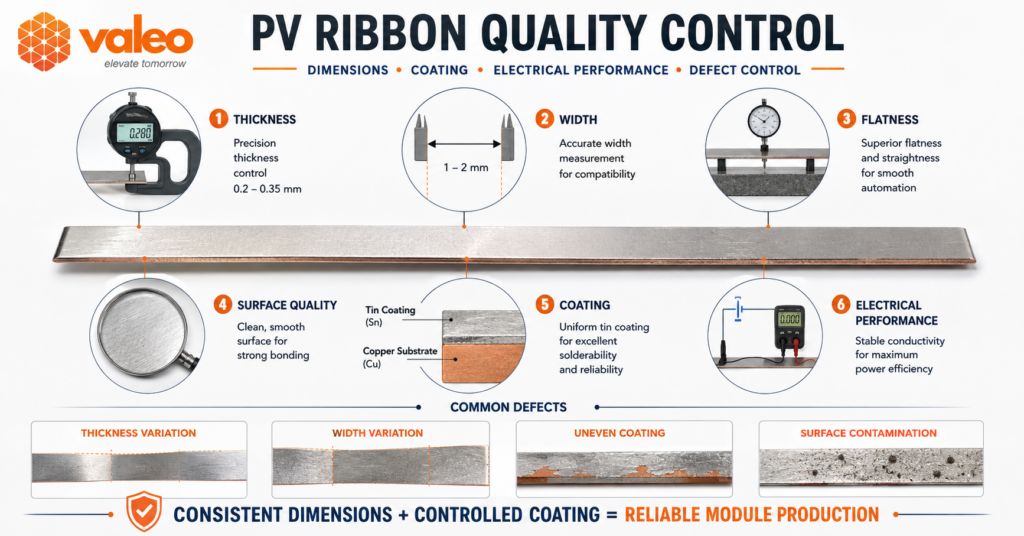
Conductivity is important, but it is not the only factor buyers should evaluate. The complete specification should match the intended application.
- Thickness: Influences electrical and mechanical behavior.
- Width: Supports alignment and equipment compatibility.
- Flatness: Helps with consistent feeding and positioning.
- Copper quality: Affects conductivity and mechanical performance.
- Coating: Influences solderability and connection consistency.
- Surface quality: Helps prevent coating and processing issues.
- Dimensional tolerance: Supports repeatable automated production.
The right combination depends on cell technology, module design, and production equipment.
Common PV Ribbon Manufacturing Defects
Small production variations can affect downstream processing. Common defects include:
Defect | Possible Cause | Potential Impact |
Thickness variation | Rolling variation | Handling or electrical inconsistencies |
Width variation | Sizing or slitting variation | Alignment problems |
Uneven coating | Coating variation | Inconsistent soldering |
Surface contamination | Inadequate cleaning | Coating or connection issues |
Edge damage | Handling or slitting | Feeding difficulties |
A strong quality system connects inspection, process monitoring, coating checks, and final testing.
What Equipment Is Used to Manufacture PV Ribbon?
A PV ribbon machine is not necessarily one universal machine. Production can involve several systems, including:
- Copper rolling and sizing systems
- Cleaning and surface-treatment equipment
- Tinning or coating lines
- Dimensional inspection systems
- Slitting equipment
- Winding systems
- Electrical and mechanical testing equipment
Equipment configuration depends on ribbon dimensions, production volume, coating requirements, product design, and customer specifications.
What Should You Consider When Buying PV Ribbon?
Price alone should not determine the choice. Buyers should evaluate:
- Width and thickness requirements
- Copper material and conductivity
- Coating type and requirements
- Dimensional tolerances
- Surface quality
- Mechanical characteristics
- Solderability, where applicable
- Spool and packaging requirements
- Compatibility with cell and module design
- Supplier quality and production consistency
The right ribbon should fit the manufacturing process rather than simply being the thinnest or lowest-cost option.
Why PV Ribbon Manufacturing Quality Matters
PV ribbon is a component, but it performs an important electrical and mechanical role inside a solar module. Manufacturing variation can affect cell interconnection, soldering, automated handling, and production efficiency.
For this reason, reliable solar interconnect manufacturing requires consistent material quality, controlled dimensions, suitable coating, careful handling, and appropriate testing. Consistent supply also matters because a suitable ribbon should perform predictably from batch to batch.
PV Ribbon from Valeo Products
Valeo Products develops copper-based products for industrial and solar applications, including tinned copper interconnect solutions.
When sourcing PV ribbon, consider the application rather than cost or one dimension. Requirements may depend on cell technology, module architecture, interconnection method, soldering conditions, automation equipment, and volume.
Need PV ribbon for your solar manufacturing application? Share your required dimensions, material, coating, quantity, and application requirements with Valeo Products to discuss a suitable ribbon solution.
PV ribbon manufacturing is the process of producing thin, flat conductive ribbon for photovoltaic module interconnection. It can include copper selection, rolling, surface preparation, coating, inspection, slitting, and winding.
Copper is commonly used because it provides high electrical conductivity and can be formed into thin, flexible ribbon. Tinned copper products add a coating when a solderable surface is required.
Tinned copper ribbon is produced by forming copper into the required dimensions, preparing the surface, applying a controlled tin coating, cooling, inspecting, and winding the product into the required supply format.
A PV ribbon machine can refer to equipment used for individual stages such as rolling, sizing, coating, inspection, slitting, or winding rather than one universal machine.
Thickness affects electrical characteristics, mechanical behavior, handling, soldering, and compatibility with the solar module's interconnection design. Consistent thickness is therefore an important manufacturing requirement.
Evaluate the supplier's ability to meet your required dimensions, material, coating, surface, tolerance, packaging, and application requirements consistently. Technical suitability and production reliability should be considered alongside price.
PV ribbon connects solar cells electrically and carries current between cells within a photovoltaic module.
Tin coating provides a solderable surface that helps create reliable electrical connections during solar cell interconnection.