The Role of Magnet Wire in Electric Vehicle Motors
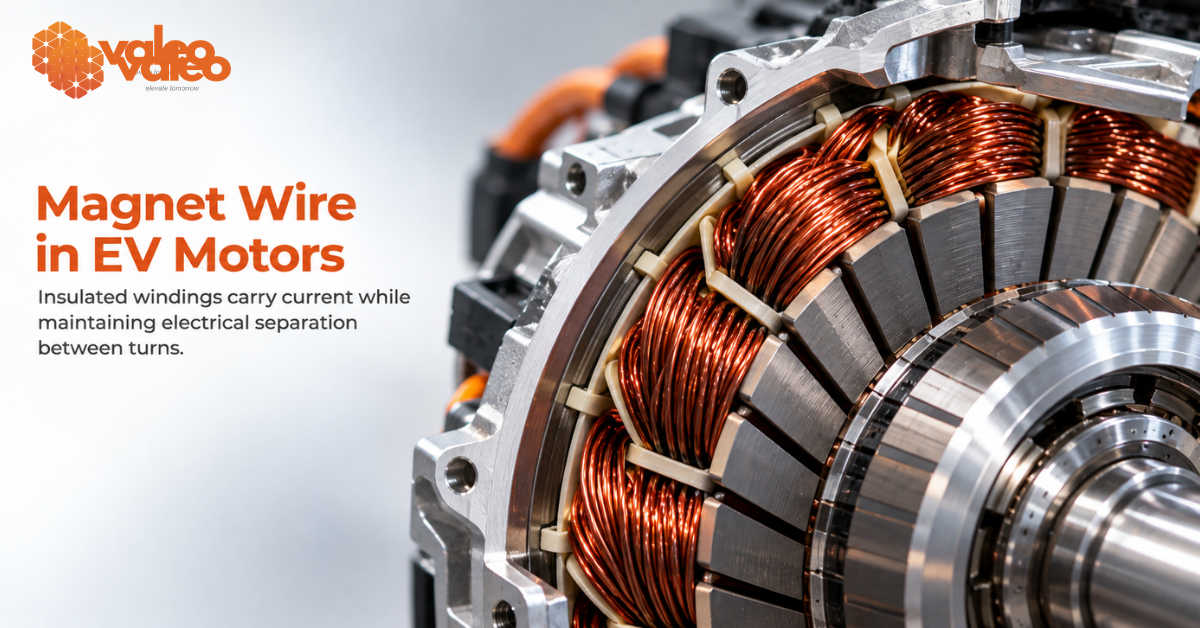
Electric vehicle (EV) motors convert electrical energy into mechanical motion, and their windings are central to that process. Magnet wire is the insulated conductor used to form these windings, allowing electrical current to pass through closely packed turns while maintaining electrical separation. In an EV motor, the right magnet wire can support electrical performance, insulation reliability, thermal management, compact winding, and consistent manufacturing.
Magnet wire has applications across automotive and electrical systems, including EV motor windings. For a broader overview of magnet wire applications, see our guide to magnet wire and its uses.
Magnet wire forms the insulated windings of an EV motor. It carries electrical current while its enamel insulation separates adjacent turns, supporting electromagnetic operation, thermal performance, and reliable winding construction.
Where Magnet Wire Fits Inside an EV Motor
An EV motor contains coils made from multiple turns of conductor. When electrical current flows through these windings, magnetic fields are produced and interact with the motor’s magnetic system to generate torque. Magnet wire provides the conductive path for this process while its insulation separates neighboring turns.
Because many turns can be positioned closely together, the insulation system is essential for maintaining electrical separation. This construction allows the winding to occupy the available motor space without creating unwanted electrical contact between adjacent conductors.
How Magnet Wire Supports Electromagnetic Performance
The motor winding carries the current required to establish the magnetic field that contributes to torque production. The conductor’s electrical resistance is therefore relevant to motor performance because resistance contributes to electrical losses and heat generation.
The wire also needs to suit the intended winding geometry and electrical design. Consistent conductor dimensions can help manufacturers produce coils according to the planned configuration and maintain repeatable winding characteristics.
This makes magnet wire part of the overall motor-winding system rather than simply a copper conductor placed inside the motor.
Why Electrical Insulation Matters
The enamel insulation surrounding magnet wire provides electrical separation between adjacent turns. This becomes particularly important when numerous conductors are packed closely together within a coil.
During EV motor operation, the winding can experience electrical and thermal stresses. Manufacturing can also introduce mechanical stresses during forming and winding. The insulation system therefore needs to maintain its intended electrical properties under the conditions expected by the motor design.
If insulation integrity is compromised, adjacent turns may make unwanted electrical contact, potentially affecting winding reliability. Insulation performance should therefore be evaluated alongside conductor properties when selecting wire for an EV motor winding.
Thermal Performance in EV Motor Windings
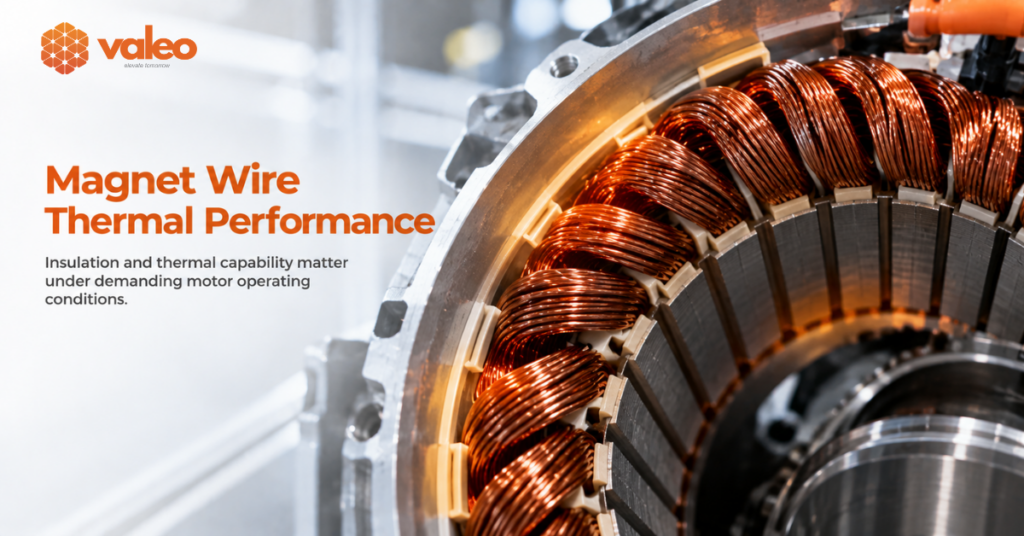
Heat is an important consideration because electrical losses in the winding generate heat, while demanding motor operation can increase the thermal load on the winding and insulation system.
According to Valeo Products’ published magnet-wire information, its range includes temperature classes from 120°C to 220°C, with insulation systems including PE, PU, PEI, PAI, and dual-coat variants. These are Valeo-specific published product characteristics, not universal requirements for every EV motor. The appropriate temperature capability should be determined from the specific motor design, operating conditions, and thermal-management system.
Magnet Wire and Compact Motor Design
EV motor designs often require effective use of available winding space. Magnet wire allows multiple insulated turns to be positioned closely within a coil, making conductor and insulation dimensions relevant to the physical construction of the winding.
Flexibility and winding behavior can also influence how effectively a coil can be formed. During controlled or automated winding, consistent dimensions can help support repeatable coil formation and predictable use of available space.
The objective is not simply to place more conductor into the motor. The winding must provide the required electrical characteristics while fitting within the motor’s physical and manufacturing constraints.
Why Consistency Matters During Motor Manufacturing
An EV motor winding needs to be produced accurately and repeatedly. Variations in conductor dimensions, insulation, or surface condition can affect winding formation and manufacturing consistency.
Relevant characteristics include dimensional accuracy, insulation uniformity, flexibility, breakdown-voltage performance, and resistance to mechanical stress. Valeo’s published quality information describes inspection and testing methods including breakdown-voltage testing, pinhole detection, and non-contact dimensional measurement.
These quality controls are relevant because consistent magnet wire can help manufacturers achieve repeatable winding structures and controlled production outcomes.
What EV Motor Manufacturers Should Evaluate
Magnet-wire selection should start with the specific winding requirements, not simply the label “EV motor.” The wire needs to match the electrical, thermal, mechanical, dimensional, and manufacturing conditions of the intended motor design.
Magnet-wire characteristic | Why it matters in an EV motor |
Electrical resistance | Influences winding losses and heat generation |
Insulation performance | Maintains electrical separation between turns |
Thermal capability | Supports operation within the expected temperature environment |
Dimensional consistency | Helps maintain repeatable winding geometry |
Flexibility | Supports forming and winding of the coil |
Mechanical durability | Helps withstand winding and operating stresses |
Considering these characteristics together provides a more useful basis for evaluation than choosing magnet wire solely because it is marketed for electric vehicles.
Conclusion
Magnet wire plays a direct role in the electrical and physical construction of an electric vehicle motor. It carries current through the windings, supports magnetic-field generation, electrically separates closely packed turns, and must withstand the thermal and mechanical conditions associated with motor operation.
For EV motor manufacturers, magnet-wire selection should be based on the requirements of the specific winding rather than a generic application label. Matching conductor, insulation, thermal, dimensional, and mechanical characteristics to the motor design can support reliable winding production, consistent manufacturing, and long-term motor performance. Manufacturers evaluating these requirements can also explore magnet wire manufacturer in India for information on available magnet-wire solutions and configurations.
FAQs
Magnet wire is used to form the insulated windings of an EV motor. It carries electrical current through the coils while its enamel insulation keeps adjacent turns electrically separated.
Insulation prevents electrical contact between adjacent turns of magnet wire. It must maintain electrical separation under the motor's expected electrical, thermal, and mechanical conditions.
Yes, magnet-wire temperature capability matters because EV motor windings generate heat during operation. The selected insulation temperature class should match the motor's operating temperature and thermal-management conditions.
Magnet wire can influence EV motor efficiency through its electrical resistance and conductor dimensions. Lower winding resistance can reduce electrical losses, while consistent dimensions support the intended winding design.
Dimensional consistency helps produce uniform and repeatable motor windings. Consistent conductor and insulation dimensions are particularly important for automated or high-volume winding processes.
Manufacturers should evaluate conductor resistance, insulation temperature capability, dimensional accuracy, flexibility, mechanical durability, and winding-process compatibility. These properties should be matched to the specific EV motor design and operating conditions.